The instrument of this survey is visibility. Every other survey method has a ruler, a tape, or a transect line that defines the area sampled. This one uses the water itself: the sample is everything the diver can see, out to the distance where the target organisms fade from view, and nothing beyond. That distance is the detection radius, written r, and it is the single most important number the diver measures. The plot being sampled is a circle whose edge is visibility.
Why bound the plot by what you can see. Ordinary plot or quadrat sampling assumes the observer detects everything inside the plot. That assumption quietly breaks the moment the plot is bigger than the observer can see — and underwater, in anything but exceptional clarity, it almost always is. Count a "10-meter plot" in 4-meter visibility and you have not counted a 10-meter plot; you have counted whatever was inside 4 meters and missed the rest, without knowing it. This method removes that error at the source: by sizing the plot to the measured visibility, the assumption "I detected everything inside the plot" is made true by construction rather than by hope. You count out to where you can see, and you stop there, because that is where detection stops.
(For the reader who likes the parallel: this is the spatial version of what astronomers do when they count stars down to a limiting magnitude — the faintest object their instrument can detect. The limiting magnitude is a detection boundary in brightness; r is the same boundary in distance. Appendix A.1 develops this.)
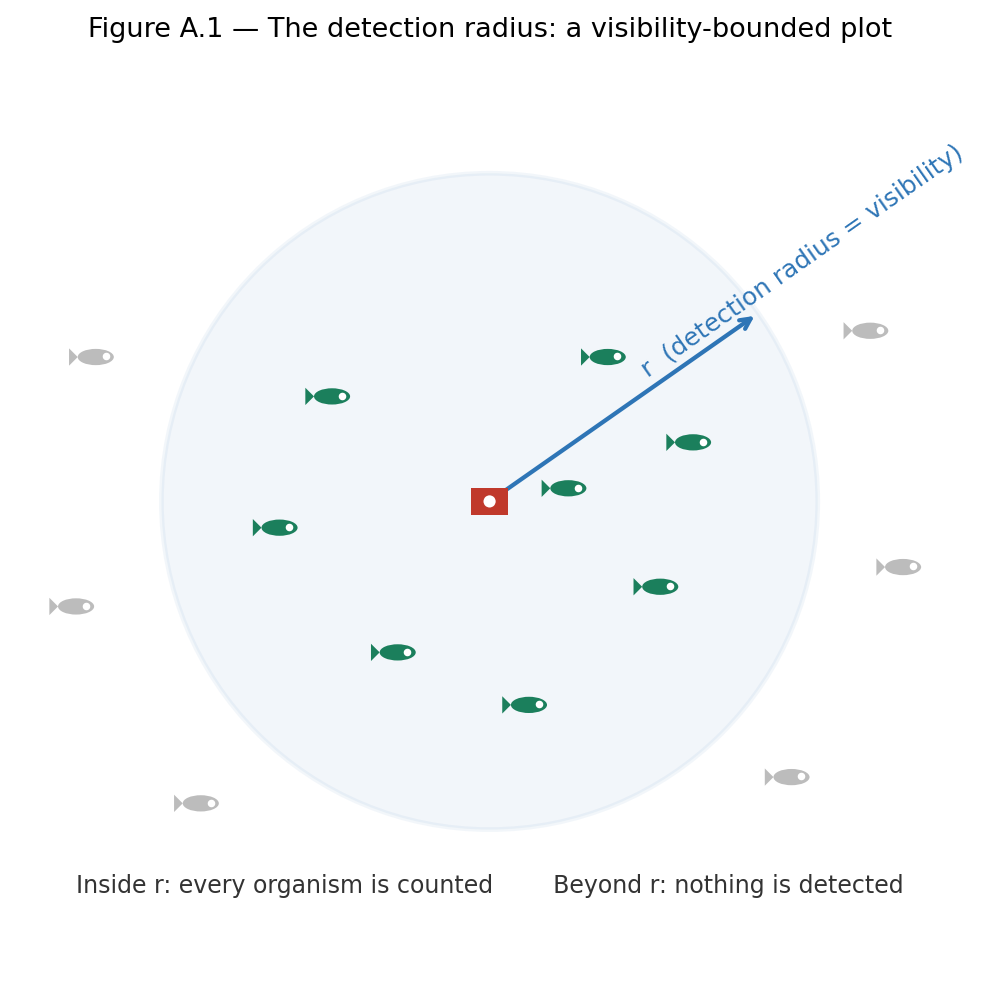
Why r is measured, not estimated. A count means nothing without the radius it was made within, because the area a diver sees grows with the square of the radius: doubling visibility quadruples the area in view. So the same station, unchanged, yields a larger count on a clear day than on a murky one — purely because more reef is in view, not because there is more life. Recording r and dividing the count by the area it defines (Module 7, Appendix A.3) is what removes that effect and makes two dives comparable. A survey that does not measure its visibility is not measuring anything repeatable.
How r is measured — the marker-fade method. Visibility is established using a marked line and a standard high-visibility marker of known size and color, by two Teams working the line together — Team A and Team B, each an intact buddy pair (see Team structure, Section One). Team A holds the marker and stays put; Team B moves out along the line together, both divers within reach of each other, until the marker can no longer be told from the background — the first Team B diver to lose it calls the fade. The distance at which it fades is r. The Teams hold visual contact with each other, and the line joins them throughout. No diver is ever sent alone to the edge of visibility — the radius is found together, on the line, in contact. This is both a safety rule and a data rule: the same standard marker each time keeps r consistent from dive to dive.
The course-standard marker. Because r is comparable only when measured against the same target, the marker is a defined object, not whatever is at hand. The course standard is a six-foot (1.8 m) high-visibility orange signaling tube — the delayed surface marker buoy ("signaling sausage") carried as standard safety equipment and available from dive-safety suppliers such as DAN. It is used here only as a fade reference: kept rolled and stowed, never inflated or deployed for calibration. Three things make it the right choice. It is a defined, reproducible size — six feet, the same for every diver and every course — so r is comparable not only from dive to dive but across divers and across sites. Its saturated orange holds contrast against open water, and its six-foot scale is a workable stand-in for the size class of organisms the census counts (Module 5). And it is already on every diver — adding no object to manage on a task-loaded survey dive, consistent with the course's minimal-kit discipline. What matters is not micrometer precision but that the same standard marker is used every time: r is an estimate of detection range, set by contrast and water far more than by the marker — even in 30 m / 100 ft of blue-water visibility, the distance at which an individual organism can still be counted is much shorter. The same marker is used for every re-survey of a site's time series, and any deviation is written on the slate, because changing the marker changes r, and changing r changes the baseline itself.
Working in kick cycles. Underwater a diver cannot read a distance in meters — only count kicks. So the survey's unit of length is the kick cycle, and r is recorded as a kick count: the number of kick cycles out to where the marker fades. The same Dive 1 calibration swim that measures r also counts the kick cycles over the marked 30 m / 100 ft line — the number K — which fixes the day's kick-length so the survey geometry can be built in kicks (Module 4, Appendix A.7). Two kick counts, r and K, come out of one calibration swim.
The wrinkle: r depends on what you are looking for. Visibility is not one number for everything in the water. A large, high-contrast fish is detectable much farther away than a small, cryptic one. So the detection radius measured with a diver-sized standard marker is honest for conspicuous targets and too generous for small or cryptic ones — most of the small organisms past that radius were never visible to begin with. This is why the survey's result is complete for conspicuous, recognizable life and only indicative for the small and hidden, and why the marker used to calibrate r should be chosen with the target organisms in mind. Module 5 and Appendix A.4 develop this; it is the largest single limitation the survey carries, and it traces directly back to what "visibility" means.