One capture, the whole circle. Once the detection radius is set, the survey records everything within it in a single capture. The tool that makes this clean is a 360° (full-surround) camera — one that records the entire horizontal field at once. Why a full-surround camera, and not an ordinary one, is worth understanding, because it is the reason the survey's area is simple to compute.
Why not an ordinary camera. An ordinary camera does not see a circle; it sees a cone — its field of view — reaching out to the detection radius. A single photograph therefore samples a wedge of the surrounding reef, not the whole circle. You could try to build a circle from several shots — north, east, south, west — but four shots leave four unphotographed wedges between them, and the diver has to rotate precisely on the spot, without finning out of position, to take them. A 360° camera removes all of that: one capture records the entire horizontal field, so the sample is the full disk the detection radius defines. One press, the whole circle, no gaps.
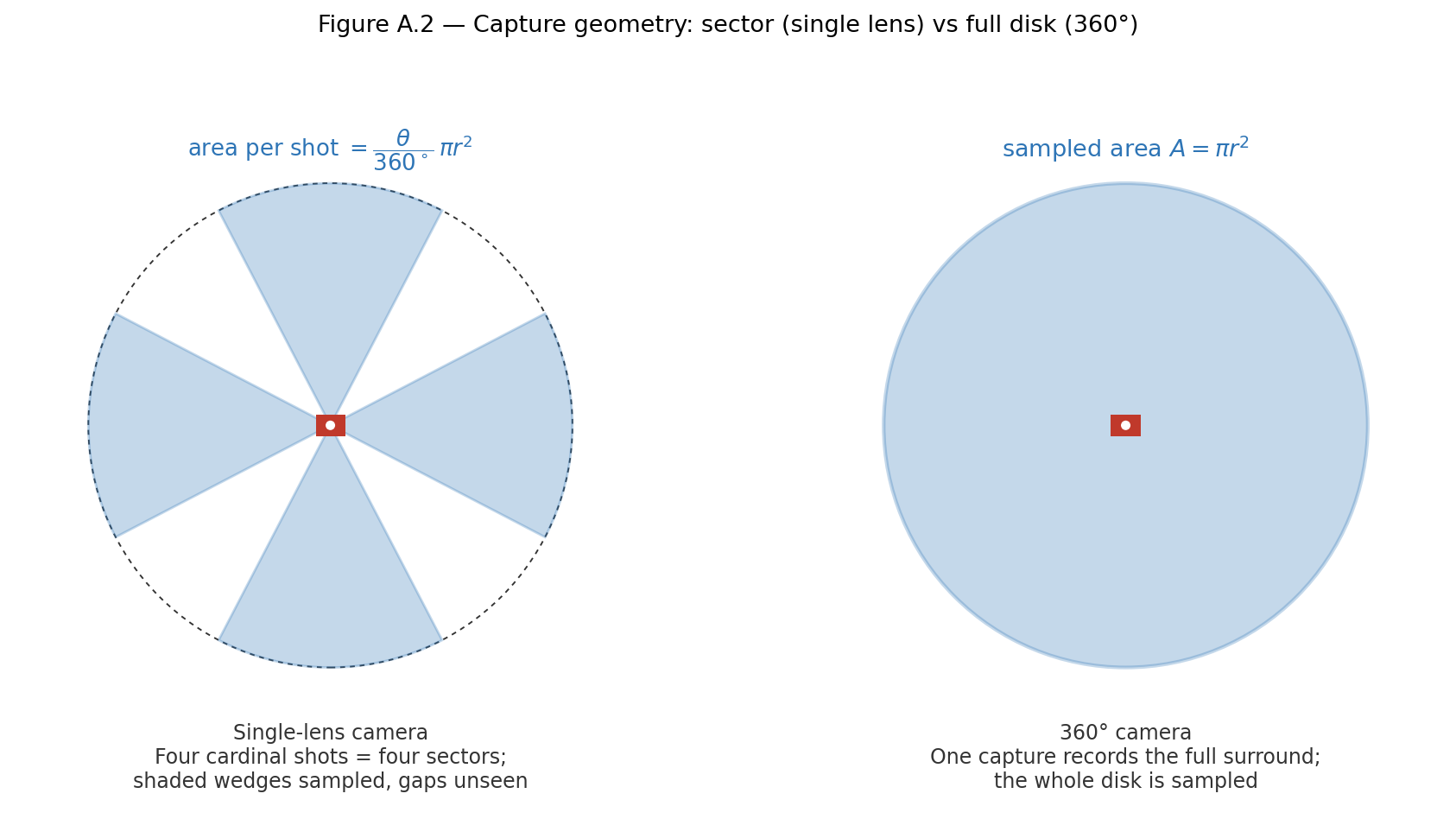
Why the clean disk matters. Because the capture is a full disk of radius r, the area it sampled is simply the area of that disk — and that single, clean number is what every count is divided by to make a density (Module 7, Appendix A.3). A four-shot panorama would force the area to be a sum of wedges with gaps, and the protocol to be a careful rotation; the full-surround capture collapses both into one press and one simple area. This is why the course specifies a full-surround camera rather than treating it as a nicety: it is what keeps the survey's arithmetic honest and the diver's task light.
What the camera must do. Any full-surround camera that meets a few requirements is acceptable; no specific brand is required. It must have enough resolution to resolve and identify the target organisms at the expected detection radius — a capture you cannot identify life in is not a survey. It must be rated to the course's depth range. And it must produce a consistent capture geometry from dive to dive, because the survey's whole value is comparison over time: a station's time series should hold the camera type constant, or record which camera produced each capture so the analysis can account for it. (The Insta360 series is named elsewhere in this guide only as a current example of a camera that meets these criteria — it is illustrative, not an endorsement.)
The camera works alone, and counting waits for the surface. The full-surround camera records autonomously underwater — the diver positions, holds a stable no-contact station, and presses once. There is no live image to monitor and no topside operator feeding instructions: identification and counting happen topside, after the dive, from the capture, unhurried. This is a deliberate division of labour. Underwater, the diver's whole attention goes to position, buoyancy, the buddy, and the gas; the demanding work of telling species apart and counting them is moved to the surface, where it can be done carefully and, if needed, checked a second time (Module 5).
The altitude you shoot from. A further part of that consistent capture geometry is the camera's altitude — its height above the reef. Height changes the angle at which the far edge of the disk is seen, and so how readily small or cryptic organisms are detected out there: shoot one station low and the next high and the detection geometry — and with it the conspicuousness of the count — shifts between them. For a relative index this cancels only if altitude is held consistent. The rule that ties altitude to the rest of the method is to measure r at the altitude you intend to shoot from, then hold that same altitude across all six stations and on every re-occupation of the hub, and record it on the slate. Altitude is not a free variable but a controlled, recorded one — set by the r measurement and held.
One honest point about a flat photograph of a living volume. A capture is a two-dimensional record of a three-dimensional volume of water. For free-swimming fish hanging in the open water column, the number in view grows with the volume seen, not the area, and a flat areal treatment would not fully remove the visibility dependence. The survey resolves this by what it counts: the counted set is restricted to reef-associated organisms — the life that lives on or against the structure's surface — for which the population is effectively spread on a surface and the areal density is the correct, visibility-cancelling quantity. Free-swimming water-column fish are outside the counted set. Module 5 develops why this restriction is what keeps the geometry honest; Appendix A.2 gives the detail.
Capture quality — what makes a frame usable. Three things a diver checks before a capture counts. First, the stitch seam and nadir: a 360° camera joins its lenses at a seam and cannot see the small cone directly beneath it, so nothing that must be counted is placed at the seam or straight down — the diver orients so the reef of interest sits in the clear field. Second, usable versus not: a frame blurred by motion, silt, or a passing diver is re-shot on the spot if gas and position allow, and if it cannot be re-shot it is flagged and excluded from the count, never counted through. Third, a pre-dive check that the camera does what the count needs — charged, storage clear, lenses clean, set to a consistent capture — done topside, because a setting found wrong underwater is a station lost. (Model-specific settings live on the course website, where perishable how-to belongs; the durable rule is that every counted frame is one a second observer could recount.)