What is counted: reef-associated life only. The survey counts the organisms that live on or against the structure — the resident, site-attached fish and invertebrates — and not the free-swimming fish hanging in the open water column. This is a deliberate choice with a geometric reason. A capture is a flat record of a volume of water; for water-column fish, the number in view grows with the volume seen, and dividing by a flat area would not remove the visibility dependence. Reef-associated life is effectively spread on a surface, so the areal density is the right, visibility-cancelling quantity. Restricting the count to reef-associated organisms is what lets the survey divide by area and get a number that means the same thing across dives (Appendix A.2).
Count the whole frame — there is no near-half. The count is everything reef-associated visible in the capture, out to the edge where things fade. It is tempting to think you could count only the organisms within some inner, closer radius — but a photograph carries no distance information about an individual fish. You cannot tell from the image how far away any one animal is; you can only know that everything visible lies within r and everything beyond r has faded from view. So there is no "near half" to count: the sample is the whole frame, and the area it is divided by is the whole disk the frame spans (Appendix A.3).
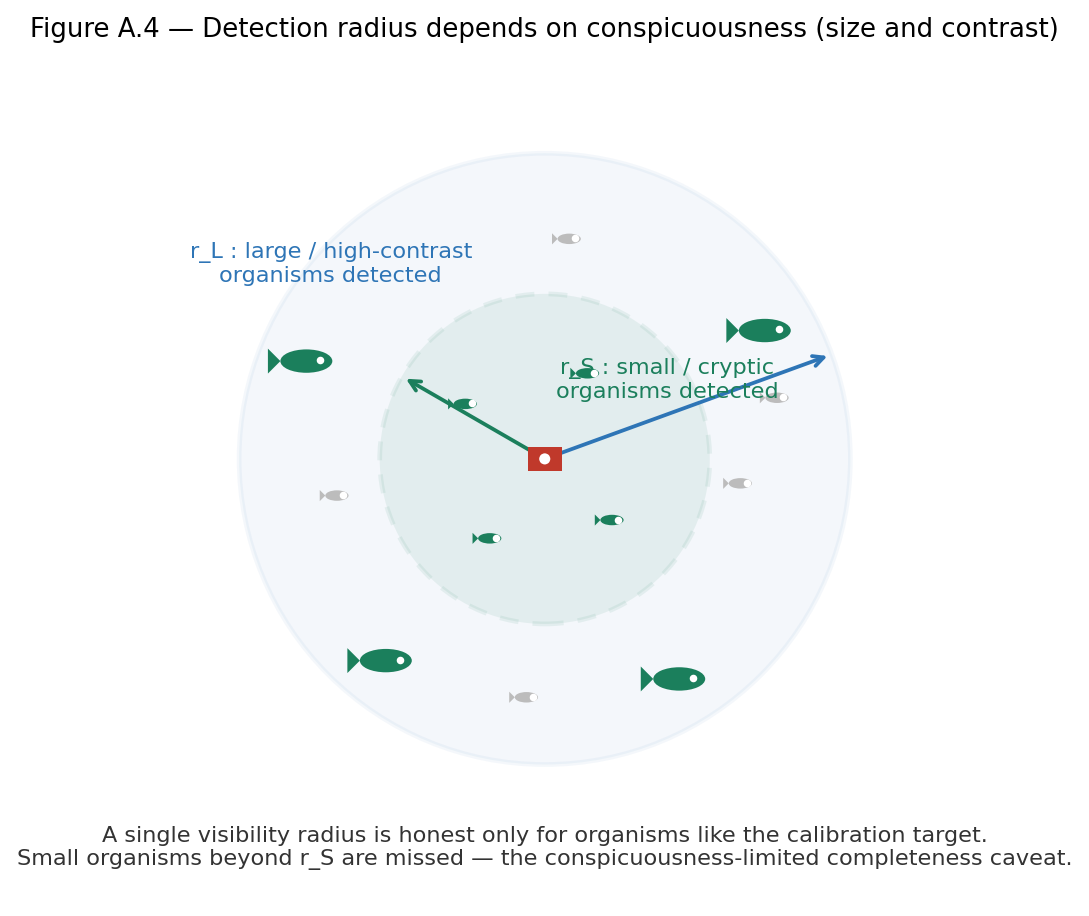
The conspicuousness caveat — the survey's biggest limitation. A diver detects a big, high-contrast fish much farther away than a small, cryptic one. So out at the edge of visibility, the survey sees the conspicuous and misses the cryptic — and a count made out to a diver-sized detection radius systematically under-counts the small and hidden. Astronomers know this exact problem as Malmquist bias: a brightness-limited survey over-represents the bright sources, because only the bright ones are detectable far away. The survey here cannot eliminate this, so it does two honest things: it restricts the count to reef-associated organisms, and it reports a relative index. For a given species, at a given station, counted the same way each time, the conspicuousness bias is roughly constant — so it largely cancels in the comparison of the same place over time, even though it would corrupt an absolute count. This is the heart of why the survey is a change-detector and not a census, and why every result states plainly: complete for conspicuous organisms, indicative for the small and cryptic.
Two observers, one scene — a count with a range. The buddy team produces two independent records of the same moment: the in-water tally the recording diver keeps, and the count made afterward from the 360° capture. Treated as two observers of one scene, their disagreement is not noise to be averaged away — it is the data that tells the survey how reliable its counting is. The reconciled count is always reported with the spread between the two observers, never as a bare single number; where they disagree, the capture is re-examined to resolve it, and persistent disagreement is recorded as a quality flag. A count that comes with its own range is an honest count (Appendix A.5).
Identifying species — topside, with iNaturalist. Telling species apart is demanding work, and it is done where it can be done well: topside, after the dive, from the capture, using the iNaturalist application for identification and logging. One extraction detail matters here: iNaturalist's vision model is trained on ordinary perspective photographs and handles raw equirectangular 360° stitches poorly, so what is uploaded for identification is a reframed perspective crop pulled from the panorama — a normal-looking flat view of the organism — not the distorted full-surround frame itself. Nothing is identified underwater; the diver's underwater job is to position, hold station, and capture. One practical rule matters for a time series: keep the counter consistent across repeated surveys of the same place, because different people draw the line between "one fish" and "two" slightly differently, and a change in who counts can masquerade as a change in the reef. The same counter, the same method, the same counted set — that is what keeps a sequence of surveys comparable.