The Problem
A camera lens is designed assuming the light entering it has been traveling through air. When that lens sits in an underwater housing, the light has been traveling through water until it hits the flat acrylic or glass port on the front of the housing. At that boundary, the light bends. Your lens is now operating in conditions it was not designed for.
The result: objects appear larger and closer than they actually are, your camera's field of view shrinks, and any photogrammetry calculation that assumed the air-rated frame width will be wrong.
Snell's Law in Plain Language
Light traveling from one medium into another bends at the boundary. How much it bends depends on the ratio of the two media's refractive indices and the angle at which the light hits the boundary. The formula is:
n₁ sin(θ₁) = n₂ sin(θ₂)
Refractive index of water is approximately 1.33. Refractive index of air is 1.00. So when light enters air from water, it bends toward the normal (the imaginary line perpendicular to the port surface). For your camera lens, this means rays that would have come in from a wide angle in pure air are now compressed into a narrower angle inside the housing.
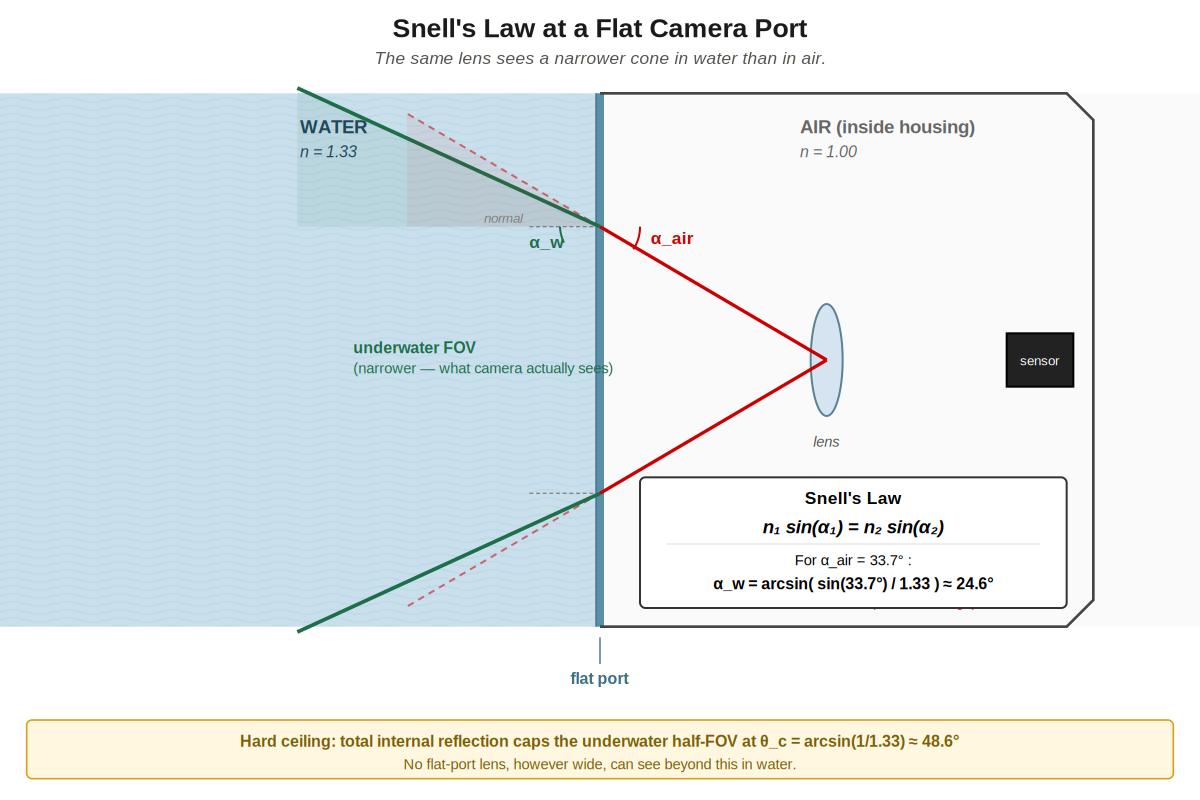
Figure 4. Snell's Law at a flat camera port. The red ray represents the air-rated FOV angle (α_air = 33.7° in this example). The green ray shows the corresponding underwater FOV (α_w ≈ 24.6°). Same lens, narrower cone.
The Field of View Reduction
If your camera has an air-rated half-FOV of α_air, then its underwater half-FOV through a flat port is:
α_water = arcsin( sin(α_air) / 1.33 )
The reduction is not a constant. The common rule of thumb "a flat port reduces FOV by 25%" is a useful approximation for moderate lenses but understates the loss for wide lenses. Here is what actually happens:
| Air half-FOV α_air | Water half-FOV α_water | FOV reduction |
|---|---|---|
| 30° | 22.1° | 26% |
| 45° | 32.1° | 29% |
| 60° | 40.6° | 32% |
| 65° | 42.9° | 34% |
| 75° | 46.5° | 38% |
Action cameras and wide-angle smartphone lenses sit in the wider rows of that table. If you use one without correcting your baseline calculation, your photos will have less overlap than you planned and the photogrammetric reconstruction may fail.
The Critical Angle: A Hard Physical Limit
There is a maximum angle at which light from water can enter air at all. Beyond that angle, total internal reflection occurs: the light bounces off the water side of the port and never crosses. This critical angle is:
θ_c = arcsin(1 / 1.33) ≈ 48.8°
So no flat-port camera can have an underwater half-FOV greater than 48.8°. The maximum underwater horizontal FOV through a flat port is roughly 97°. You can buy a 180° fisheye lens, put it in a flat-port housing, and physically cannot use more than half of it. The light at the edges of the frame literally cannot reach the sensor.
Dome ports defeat this limit by curving the air–water boundary so that rays cross at near-normal angles. They do not eliminate the underlying physics; they just hide it. If your housing has a flat port, the critical angle is your ceiling.
Why This Matters for Your Baseline
Your camera's spec sheet quotes an air-rated FOV. If you use it to calculate the frame width at your subject distance, you overestimate the actual underwater frame width. Your calculated baseline will be too long. You will move too far between shots. Your overlap will be insufficient. Your photogrammetric reconstruction will have gaps.
Correct the frame width using exact geometry. At a subject distance L, the underwater frame width is:
W = 2 × L × tan(α_water)
Compute the underwater half-FOV α_water first (the arcsin formula above), then take its tangent. Do not just shrink the air-rated width by the FOV-reduction percentage — frame width grows with the tangent of the angle, not the angle, so that shortcut overstates the underwater width (by about 14% at a 45° air half-FOV, 37% at 60°). Then use W in B = W × (1 − O).
Try it online: the Refraction & FOV calculator in the Tools section at reefcartographer.com
Self-Check
1. Your camera has an air-rated half-FOV of 45°. What is the underwater half-FOV through a flat port?
2. Your subject is 2 m from the camera and your underwater half-FOV is 32° (from question 1). What is the underwater frame width on the subject?
3. Why can a dome port have a wider underwater FOV than a flat port of the same diameter?
Answers
1. α_water = arcsin(sin(45°) / 1.33) = arcsin(0.707 / 1.33) = arcsin(0.532) ≈ 32.1°.
2. W = 2 × 2 × tan(32.1°) ≈ 4 × 0.628 ≈ 2.51 m. (Note: the air-rated width at this distance would be 2 × 2 × tan(45°) = 4.0 m, so the underwater frame is much narrower — use the tangent of the underwater angle, never a percentage shortcut.)
3. A dome port curves the air–water boundary so that light rays from all directions cross it close to perpendicular (normal incidence). Snell's Law has no effect on perpendicular rays, so the bending and the critical-angle ceiling are largely avoided. The lens sees a virtual image that behaves much like its in-air view.