Learning Objectives
By the end of this knowledge development session, student divers will be able to:
- Describe what a thermocline is and state two mechanisms that create one over a reef.
- Explain why a shallow reef is often isothermal, and why finding no vertical structure is a valid result.
- Explain why the logger array must be deployed simultaneously rather than lowered through the water column in stages.
- State the approximate time an immersed logger requires to reach thermal equilibrium, and explain the consequence of recovering it too early.
- Explain why at least three loggers are used rather than two.
- Explain why the average of readings taken at different depths in a stratified column is not a meaningful number.
- Describe why depth-holding accuracy, rather than sensor accuracy, dominates the uncertainty of a measured thermal gradient.
Presentation Notes
a. Warm water floats. Seawater expands slightly as it warms, so warm water is less dense than cold and sits above it. When the sun heats the surface of a calm sea, it builds a layer of warm light water lying on cooler heavier water beneath. The boundary between them — the depth range over which temperature changes fastest — is called a thermocline.
b. Wind and waves fight it. Surface mixing stirs the warm layer down and the cool water up. Whether a reef has a thermocline on a given day is a contest between heating, which builds structure, and mixing, which destroys it. Calm sunny weather builds; wind and swell erase.
c. On a shallow reef, mixing usually wins. Over twenty or thirty feet of water with any wave action at all, the column is frequently uniform from top to bottom — isothermal. This is not a failed dive. A column with no measurable gradient is a real finding about the water on that day, and it is the correct answer far more often than students expect. What matters is that you can tell the difference between "no gradient" and "a gradient too small for my instruments," and Topic 3 gave you the tool for that. Note what this means for the word itself: a column you cannot resolve a gradient in is isothermal at your threshold, not isothermal absolutely.
d. Shallow water heats faster, and the warm water goes somewhere. This is the mechanism most likely to confuse you, so it is worth following carefully.
Shallow water warms faster than deep water, because the same sunlight is heating a much smaller volume. Over a reef flat or inside a lagoon, this can raise the temperature well above the water offshore in the course of a morning. That warm water is less dense, so it floats — and on a falling tide it drains off the flat and slides out over the cooler offshore water as a thin surface layer.
A diver on the fore-reef may then find warm water at the top of the column that was heated somewhere else entirely. And it looks exactly like ordinary surface heating at your own station: warm at the shallowest logger, unchanged at depth. Telling the two apart requires knowing the tide, which is why tide state and direction are recorded before every dive.
e. Two other mechanisms worth knowing. Cool water can be drawn up a reef slope from deeper water, driven by tide or by current running along the slope — upwelling, which produces the opposite signature: cooler at depth than the day's heating would explain. And fresh water entering from land is less dense than seawater regardless of its temperature, so it floats and forms a distinct surface layer; without salinity measurement you will see this as a temperature anomaly at the surface and will not be able to confirm what caused it. Say so if you suspect it.
f. The sensor is slow, and this changes everything about how you use it. A logger dropped into water at a different temperature does not read the new temperature immediately. It takes roughly seven minutes to come within ten percent of the true value, and something like twenty minutes to settle fully. This is not a fault. It is a consequence of the sensor sitting inside a housing with thermal mass, and every submersible logger in this price class behaves similarly. Pre-conditioning the loggers in site seawater, as Topic 3 describes, reduces the size of the transient but does not remove it.
g. Therefore you cannot lower an instrument through the water and read as you go. If you stop at ten feet for three minutes, then twenty for three, then thirty, each reading is a smeared average of everywhere the logger has recently been. It lags. A sharp thermocline — the very feature you are looking for — comes back blurred into a gentle slope, and the error is not correctable afterward, because you cannot recover what the smearing removed.
h. So the array is deployed all at once and left alone. The loggers are attached to a mooring line at fixed depths on descent, and they stay there. Each sits at one depth long enough to fully equilibrate, and each records at the same time as the others.
i. That last point is worth more than it appears. Because the sensors record simultaneously, your profile is a snapshot of the water column at one instant. An instrument lowered in stages produces a profile in which depth and time are mixed together: the surface reading was taken before the deep reading, the sun moved, the tide turned. A simultaneous array has no such confusion. This is better practice than a staged cast, not a compromise forced on you by a slow sensor.
j. The thirty-minute rule applies to the instrument, not to you. No reading is used in the Station Report unless its logger has been at station depth for at least thirty minutes. Note that this is a requirement on the loggers, which hang on a line, and not on the divers, who do not. The array may be in place before you descend and may remain after you surface; what matters is that each logger settled before the reading you use.
k. Your own computer has a thermistor too, and it is always chasing. The loggers sit still and reach equilibrium. The thermistor on your wrist moves with you, so it is always lagging slightly behind the water it is currently in. On the horizontal survey in Dive 3 this matters directly: a reading taken immediately on arriving at a new position describes the water you just left as much as the water you are in. Allow dwell time, and use the stationary array as the reference that shows how large the effect is.
l. Two loggers give you a gradient; three tell you whether it means anything. With sensors at two depths you can compute an average change per metre, but you cannot tell whether the water changes smoothly between them or sits in two distinct layers with a sharp step. A third sensor in between distinguishes those cases. If the middle reading falls on the line between the outer two, the change is gradual. If it does not, there is structure — and structure is the interesting result. Even spacing is what makes this test work; unequal intervals make the comparison much harder to interpret. This is also why the array scales with the site: one logger for every 3 m / 10 ft of water column, and never fewer than three.
m. Do not average readings from different depths. An average is only meaningful when the numbers are repeated samples of one quantity. Three loggers in a calibration bath are exactly that: one bath, one temperature, three attempts at it — so the mean is meaningful and the spread is the noise floor. Three loggers at three depths in a stratified column are not. They are measuring three different things, and their average describes water that exists at no depth whatever. A column reading 28.5, 27.8 and 24.1 °C has a mean of 26.8 °C, and there is nowhere in that column where the water is 26.8 °C.
The median is no better and arguably worse, because it returns a number that is a real reading — from one particular depth — and presents it as though it characterized the whole column.
Be careful about the reason. It is not that the numbers are far apart: widely scattered readings of one quantity still have a meaningful mean. It is that they are measurements of different quantities. The test for which case you are in is the linearity check in note (l): where the column tests as uniform, a station mean is defensible, and its spread should look like the bath spread. Where it does not, report the profile and no summary statistic.
n. Depth is the axis, and your buoyancy is what sets its accuracy. Every temperature in your profile is paired with a depth, and that pairing is only as good as your knowledge of where the logger actually was. The logger does not know its own depth. It is recorded by a diver, from a dive computer, at the moment of attachment — never estimated from how much line is out, because a moored line leans with current and its length is not its depth.
o. And your buoyancy matters more than your sensor. Consider a thermocline of one degree over ten feet. That is a tenth of a degree for every foot of depth. Now recall that a cross-calibrated array resolves about four hundredths of a degree. If you know a logger's depth to within a foot, you have introduced a tenth of a degree of uncertainty into its temperature — roughly two and a half times the sensor's contribution. Depth-holding, not sensor quality, is the largest error in the measurement.
p. This is the honest answer to a fair question. A student may ask why a diving course spends time on buoyancy when the instruments do the measuring. This is why. In this course, buoyancy control is not a comfort skill or a conservation courtesy — it is a specification of the instrument, and it is the specification you personally control. A diver who holds depth to within a foot produces measurably better science than one who holds it to within three, and the difference is computable from their own dive log.
q. Record what you actually achieved, not what you intended. The standard for this course is depth held within about a foot where conditions permit. Surge does not always permit it. What matters is that the achieved variation is read from the dive computer log and carried into the uncertainty statement, so that a Station Report made in rough conditions declares a larger uncertainty rather than a false one.
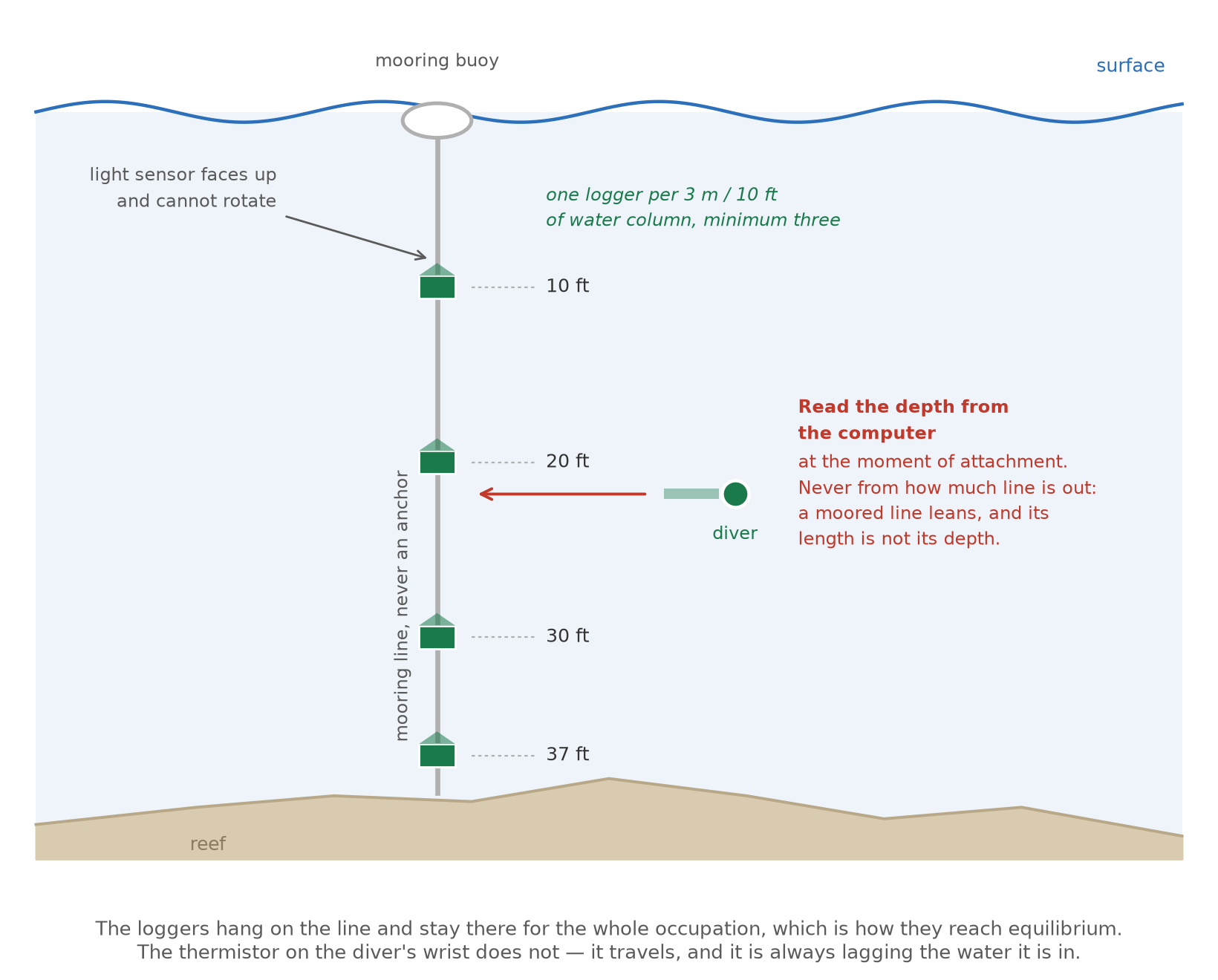
Side elevation. Loggers hang on a mooring line at nominal 3 m / 10 ft increments and stay there for the whole occupation, which is how they reach equilibrium. Each logger's depth is read from a dive computer at the moment of attachment — never inferred from how much line is out, because a moored line leans and its length is not its depth.