Learning Objectives
By the end of this knowledge development session, student divers will be able to:
- Explain why a black target is used rather than a reflective one, and why this makes the measurement independent of how bright the day is.
- Explain why the measurement is made horizontally rather than vertically over a reef.
- Describe the two-Team procedure for measuring extinction distance and explain how it keeps buddy pairs intact.
- Determine their own kick-cycle distance and state its uncertainty.
- Explain why the two Teams should in theory lose sight of each other at the same moment, and what a disagreement between them measures.
- State the correct record when the target never disappears within the agreed separation.
- State why the diameter, shape and finish of the disc are fixed by the course standard rather than left to the instructor.
Presentation Notes
a. A black target has a property nothing else has. Look at a black disc underwater and the light reaching your eye from it is not light reflected off the disc — a truly black surface reflects almost none. It is light scattered into your line of sight by the water in between. The disc therefore appears not as an object but as an absence, and it fades from view as the water between you and it fills that absence in.
b. That is why it does not matter how bright the day is. As the sun goes behind a cloud, both the light scattered into your line of sight and the general background darken together, in the same proportion. The contrast between the disc and its background does not change, and contrast is what determines whether you can see it. A white or black-and-white target reflects light, so its appearance depends on how much light is falling on it, which depends on depth, sun angle and time of day. The black disc removes all of that.
This is the opposite of the light measurement in Topic 5, where the raw reading depends entirely on the sky and only the ratio is usable. Here, the raw reading is the usable quantity, and no correction for conditions is needed. Two very different instruments, and it is worth understanding why one needs a ratio and the other does not.
c. Extinction distance is a direct measure of a property of the water. Because the disc's disappearance depends only on the water, the distance at which it vanishes is a measurement of how strongly the water removes light along a straight path. That quantity is called the beam attenuation coefficient, written c, and it is one of the fundamental optical properties of natural water. The relationship between the extinction distance and c is simple, and is derived in the Technical Supplement, section A.4.
d. This is a published method, not an improvisation. The horizontal black disc technique was developed for freshwater monitoring in the 1980s and has been a national water-clarity standard for decades. In direct comparisons it has been found to repeat slightly better than an electronic turbidity meter, and to track suspended solids more closely. It is worth knowing that a disc costing a few dollars can outperform an instrument costing several hundred, and worth knowing why: turbidity readings depend on the design of the instrument, whereas beam attenuation is a property of the water itself.
e. Why horizontal and not vertical. The familiar way to measure water clarity is the Secchi disc — a weighted disc lowered until it disappears, with the depth recorded. It is the oldest instrument in the field, in use since the 1860s, and it remains perfectly good in deep water.
Over a Caribbean reef in twenty to thirty feet of clear water it fails twice. The disc reaches the bottom while still plainly visible, so there is no measurement at all — only "deeper than the site." And a weighted disc lowered onto coral damages it.
The horizontal method has neither problem. There is unlimited path length sideways, and nothing is lowered onto anything.
f. The measurement is made by two Teams, and nobody is ever alone. Each Team — a buddy pair, within reach of each other throughout — carries its own black disc. Both Teams start together, then swim apart on reciprocal bearings. Each Team looks back at the other Team's disc and notes the moment it disappears.
Nothing is deployed and nothing is left behind. The discs are carried, which means nothing rests on the reef and nothing has to be recovered separately.
g. Both Teams are moving, so each extinction event measures the whole separation. This is the part most easily got wrong. When Team A loses sight of Team B's disc, the distance between them is everything both Teams have swum — Team A's kick cycles plus Team B's, counted up to that moment. The same is true when Team B loses sight of Team A's disc.
So each Team's observation produces a complete estimate of the extinction distance, not half of one. Two Teams, two independent estimates of the same quantity, and the measurement is their average.
h. Which means you have to know when. Team A's disc vanishes at one moment; Team B's at another, usually a little later or earlier. When A's event happens, B does not know it and keeps swimming. So each Team notes the time of its own extinction event from its dive computer, along with its running kick-cycle count. Afterwards, each Team's count at each of the two timestamps can be reconstructed, giving two complete separations.
This is why the clocks are synchronized before the dive. Without a common time base the two counts cannot be paired, and the measurement falls apart.
i. The two estimates will differ, and that difference is a measurement. Eyes differ. Acuity differs, masks differ, and observers differ in how conservative they are about declaring something gone. The published literature is explicit that the method depends on the observer's visual acuity, and that variability between individuals is greatest when the water is clearest — which is precisely the regime a reef diver works in. That is not a reason to distrust the method. It is the reason two Teams are required: the difference between their two estimates is the between-observer spread for this observation, obtained exactly as the bucket obtains it for the loggers, except that here the instrument is a person.
One diver in each Team is the designated observer. That diver watches the other Team's disc and calls the extinction event. Their buddy counts kick cycles, holds the bearing and minds the pair. The measurement therefore produces two independent estimates, one per Team, and it is the difference between those two that gives the observer term in u(y): half of it, combined in quadrature with the kick-cycle term.
This is a deliberate choice over having all four divers judge independently. Four judgements would say more about observer variability, but the dive is already task loaded, and a diver simultaneously counting kick cycles, holding a bearing and watching for an extinction event does none of the three well. Assign the roles before entry and record who observed.
j. Distance is measured in kick cycles. A kick cycle is one complete up-and-down movement of both fins, and it is the standard underwater measure of distance covered. Every diver's kick cycle is different — different legs, different fins, different technique — so each diver calibrates their own on Dive 1 by swimming a course of known length and counting. The result is a personal conversion factor, in metres per kick cycle, which that diver uses for the rest of the course and records in the Station Report alongside every measurement that depends on it.
k. A tape would be more accurate, and we are not using one. The standard guidance for scientific diving is that measured tapes and knotted lines give more comparable distances between different divers than kick cycles do, which matters when data from several people will be combined. That guidance is correct, and the trade-off is deliberate here for two reasons. A line long enough to span reef visibility is an entanglement hazard over coral, and it sags: paying out thirty metres of line does not put the far end thirty metres away. Kick cycles cost accuracy and buy a measurement that can be made safely over living reef with nothing deployed. State the cost in the report rather than hiding it.
l. Kick cycles are the largest uncertainty in this measurement. A calibrated kick cycle is good to roughly ten percent, considerably worse than the loggers or the disc itself. Because the beam attenuation coefficient is inversely proportional to the distance, a ten percent error in distance is a ten percent error in the reported coefficient. Averaging the two Teams' estimates improves this but does not remove it.
m. Three habits reduce it. Swim a straight line — any wandering adds path length that was not separation, which always makes the water look clearer than it is. Swim at a steady, ordinary pace, because a kick cycle calibrated at cruising speed does not describe a sprint. And prefer to work across the current rather than into or with it, since a current carries one Team faster than the other and puts a systematic error into both estimates in the same direction. Where current cannot be avoided, repeat the measurement with the Teams' directions reversed so that the bias cancels.
Where the reversed repeat is conducted, both runs are recorded and averaged. Complete the disc observation block twice, noting each run's bearing, and report the mean of the two runs as the extinction distance. The difference between the two runs is recorded as an additional spread — it is a measure of how much the current was affecting the result, and a large one is a reason to distrust the figure rather than a reason to hide it. Without a stated rule two instructors would combine the runs differently, so this is the rule: mean of the runs, difference recorded.
n. Kick-cycle calibration is a navigation skill, not just a measurement one. Every diver who leaves this course knows how far they travel per kick cycle, which is the foundation of underwater natural navigation. This is worth having independently of any measurement, and it is one of the few things in this course that improves ordinary recreational diving directly.
o. Move until it vanishes, then stop. Bracket from a standstill. A single judgement of "gone" is soft — the disc fades rather than switching off, and different observers place the moment differently.
The vanish event is the measurement. Note the moment the disc becomes indistinguishable from its background, stop, and record the time and your cycle count. That is the observation the reported extinction distance is built from, and it is the one the reconstruction can locate exactly.
The reappearance is a separate quantity, and it is not part of the distance. Having stopped and recorded, close toward the other Team until the disc reappears, and note that distance too. The gap between vanishing and reappearing measures how sharp your own judgement was — a narrow gap means a crisp threshold, a wide one means you were guessing over several metres. It is recorded as observer quality, not averaged into the result.
This is a deliberate choice. Reconstructing the separation at the moment of reappearance would require knowing where the other Team was at a third moment, adding another interpolation and another assumption to sharpen a threshold that the vanish event has already established. The course takes the cleaner measurement and reports the bracket alongside it.
So two spreads come out of one measurement, and they mean different things. The gap between the two Teams' estimates is the spread between observers; half of it is the observer term in u(y). The gap between vanishing and reappearing is the spread within one observer. A team whose two Teams agree closely but whose individual brackets are wide has learned something different from a team with the reverse.
p. Colour vision affects the threshold, and should be recorded. The underlying relationship is defined for the photopic range of normal human vision. A diver with colour vision deficiency has different sensitivities and will not judge extinction at the same point as a diver without. This is not a reason to exclude anyone from the measurement — it is a reason to record it, so that a persistent difference between two observers can be explained rather than treated as noise.
q. Sometimes the disc never disappears, and that is a result. In very clear water the agreed maximum separation may be reached with the target still plainly visible. The correct record is "greater than" that distance. This is a censored observation, exactly like an instrument reading below its detection limit, and it is reported as such — never as an estimate, and never as a reason to keep swimming past the agreed limit. The separation limit is set before entry, and clear water is precisely the condition in which it must be respected, because poor visibility limits itself and good visibility does not.
r. Look at open water, not at the reef. The disc must be seen against a uniform background. Sighted against coral structure, shadow and colour, the disappearance is a different event and the measurement is not comparable to one made against open blue. Choose the orientation before the swim, and record it.
s. The disc is fixed by the course standard, and here is why each part is fixed. Section One gives the specification: a 200 mm disc cut from opaque black polycarbonate sheet, both faces abraded matte. Each element matters.
Black through the material. A coated disc can peel or scratch through to a lighter substrate, and a partly-failed black surface reflects unpredictably — which destroys the property that makes the method work at all.
Matte, checked in water. A surface that looks matte in air can show a specular highlight at a grazing angle underwater. The moment the target returns light, it is no longer a black target.
A disc, not a square. The published relationship is calibrated on circular targets. A square's corners subtend a smaller angle than its body and fall below the eye's resolving power first, so it degrades into an ambiguous shape rather than fading uniformly, and observers disagree about when it has gone.
200 mm. The published freshwater method uses targets of 20 to 60 mm, suited to sighting ranges of a metre or two. Reef visibility is one to two orders of magnitude greater, and a target that small would become unresolvable before it became invisible — at which point you are measuring your own eyesight rather than the water. Supplement A.4 gives the calculation.
Because the point of a standard is that reports from different instructors in different oceans can be compared, none of these is the instructor's choice.
Appendix reference. The contrast decay law, the relationship between extinction distance and beam attenuation, the treatment of censored observations, the geometry of the two-Team measurement and the propagation of kick-cycle uncertainty are given in full in the Technical Supplement, sections A.4 to A.6. The primary sources for the method are listed in Supplement D.
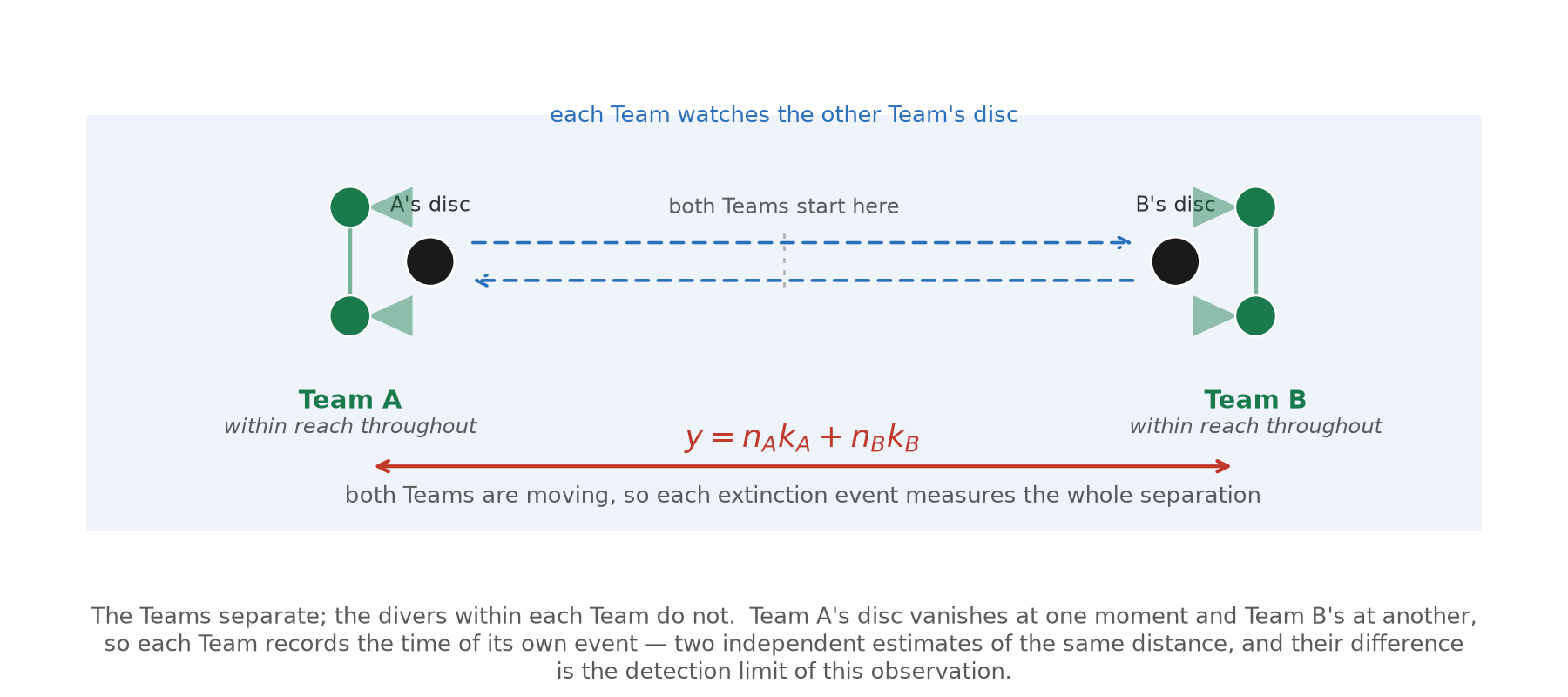
Seen from above. Each Team carries its own disc and watches the other Team's. Both Teams are moving, so each extinction event measures the whole separation — everything both Teams have swum — not half of it. The Teams separate; the divers within each Team do not.